The Playlist has the extended breakdown:
Absence makes the heart grow fonder. Perhaps legendary filmmaker Terrence Malick knew this when he worried aloud and said in his last interview in the 1970s, “From this point on. I’m being watched. That could trip me up.” Malick wasn’t referring to detectives—though cinephiles possibly could have used some in the ‘80s and ‘90s. This was in reference to critics, audiences and studios coming to the realization that after “Badlands” and “Days of Heaven,” Malick was possibly the most important American filmmaker alive.
Such existential worries, plus studio pressures on the project “Q” forced Malick to fly the coop, pulling one of cinema’s greatest disappearing acts, one that would last 20 years. “I think the more applause he got, the more frightened he got,” screenwriter pal Bill Witliff said of Malick’s departure in a 1995 Los Angeles magazine interview. “I knew he wasn’t long for this business,” producer Don Simpson, who’d hung out with Malick on “Days of Heaven,” said in the same article. “He never loved the movies - he was more the philosopher.”
But longtime editor Billy Weber, who has worked on every Malick film to date, said the vacation was never meant to be two decades long. “He just got waylaid for 20 years,” he said on the “Days of Heaven” commentary track for Criterion. Furthermore, ideas that Malick was reciting poetry, painting or had called it quits were dead wrong. He was working throughout the entire period and wrote several screenplays. “Terry’s continually working, He has a project he’s been working on for 30 years and he just doesn’t talk about it,” Jack Fisk said on the same commentary track, likely referring to “Q” or what became “The Tree of Life.”
Some are positive they know why Malick vanished from the film industry so suddenly and mysteriously. ‘‘That’s easy,’’ John Travolta said, not exactly modestly, in a 1999 EW article about “The Thin Red Line.” ‘‘He hired me for ‘Heaven,’ I couldn’t do it, it broke his heart, and he never wanted to do a movie again. It was the most romantic notion I’d ever heard.’’ Others closer to his inner circle claim to know the answer as well, but they’re not saying. “I know why he left, but that’s just for us,” Billy Weber said in the 1999 Premiere article “Welcome to the Jungle.” Frankly, anyone keeping silent probably has more knowledge than those speaking out of turn.
But whatever the case was, and it was likely a confluence of several issues, conflicts and problems rather than one just quote-worthy talking point that would satisfy the public, Terrence Malick was not idle in his 20 years away from directing films. “The Tree of Life” went into wide release last Friday and leading up to the release we’ve been tracking the films of Terrence Malick and all their behind-the-scenes happenings, from his debut, “Badlands,” his prairie-set drama, “Days of Heaven,” his triumphant return 20 years later with the WWII epic, “The Thin Red Line,” the Pocahontas picture, “The New World,” right through to his most recent film, the metaphysical and spiritual ‘Tree of Life.’ In our final installment in this series, we chart everything in between: the unpublished screenplays and unmade projects of Terrence Malick.
“Sansho the Bailiff”
While the popular myth is that Terrence Malick simply disappeared between “Days of Heaven” and “The Thin Red Line,” as always, the truth is a bit more blurry. He continued to write screenplays and two projects had progressed considerably: “The English Speaker” (which we’ll get to below) and “Sansho the Bailiff,” developed by entrepreneurial producers Bobby Geisler and John Roberdeau. Malick had first met Geisler way back in 1978 when the budding producer offered him the gig of directing an adaptation of David Rabe’s play, “In The Boom Boom Room.” While he turned that down, the two then worked on a film about 19th Century freakshow attraction Joseph Merrick but that too was scuttled once David Lynch delivered “The Elephant Man” on the same subject.

A decade later, Geisler reconnected with Malick, with Roberdeau in tow, with an offer for the helmer to tackle an adaptation of D.M. Thomas’ novel “The White Hotel.” Malick countered with a proposal to direct Molière’s “Tartuffe,” but eventually they agreed on “The Thin Red Line” (and you can read about how that all went down right here).
While Malick got to work on “The Thin Red Line” under a loose contract that afforded him many opportunities to leave, the producers knew they had to do something to stay in contact with the director. “It was important that we find a way to remain in continual touch with Terry,” Geisler told Vanity Fair. “The best way to do that was to commission him to develop another project.” They enticed the director to write a stage play based on the fable “Sansho the Bailiff,” which film buffs know was turned into a great movie by Kenzo Mizoguchi in 1954. What was in it for Malick? $200,000 plus $50,000 when it opened on Broadway.
In 1990, after intensive research paid for by the producers, including tracking down anything and everything Malick could ask for (quite the task, given the man’s famed, endless curiosity), the helmer turned in his first draft which was promptly sent out to directors Peter Brook, Peter Stein, and Ingmar Bergman—who all turned it down. However, getting a great director to stage the production was still the goal and the producers eventually found their man.
In 1992, Polish director Andrzej Wajda—best known for his trilogy “A Generation,” “Kanal” and “Ashes and Diamonds”—agreed to the job after flying to New York City and watching “Badlands” and “Days of Heaven” (he was not familiar with Malick’s work previously). So Malick flew to Warsaw, but it was not a meeting of minds. After a grand dinner, Wajda is reported to have told Malick, “Terry, what you need to do to “Sansho the Bailiff” is make it more like Shakespeare.”
While lighting designer Jennifer Tipton, sound designer Hans Peter Kuhn, and a collection of fine Asian-American actors were brought together for a $600,000 “workshop” at BAM, the relationship—if there ever was one—between Wajda and Malick dissolved. The former demanded rewrites while the latter bemoaned Wajda’s inability to engage with the material.
From there things just got worse as costs rose to $800,000 and the producers were besieged by creditors. “It was ridiculous. We were sitting on all these assets that we had sunk our money, blood, and time into. It was time to put Terry on notice,” Roberdeau said, with Geisler adding that Malick refused “to take any responsibility whatsoever. Our problems were our problems. He had forewarned us in the beginning that his timetable would be his timetable, and if we were still standing by the time that he got around to directing one or both of the movies, that would be great.”
While all three soured on the relationship, they began to narrow down their choices for their next venture to two possible projects: “The English Speaker” or “The Thin Red Line.”
“The English Speaker”
While most people assume that anything Terrence Malick worked on during his infamous 20-year hiatus was in the early ‘80s or late ‘70s and the rest of the time he studied the cloud-filtered light out of his Paris apartment, “The English Speaker” is an unproduced screenplay that comes from the early ‘90s (a 2nd draft dated 1992 was for sale on Ebay in 2010, but was swiftly bought, presumably by Malick’s eagle-eyed team).

1992 seemed to be the year the film industry believed Terrence Malick would be returning (or shortly thereafter); Variety even wrote profiles on his possible return, but of course Malick’s indecisiveness and molasses-like pace meant that “The Thin Red Line” wouldn’t surface to the public until late 1998.
However, “The English Speaker,” known to be a tale of 19th century psychoanalysis, was a project that Malick had been working on even ahead of his ponderous WWII effort. “It’s something Terry’s been thinking about since before ‘Days of Heaven.’ But it’s new, not one of his old projects,” producer Bobby Geisler told Variety in October of 1992—Geisler and his partner John Roberdeau of course being the aforementioned producing pair that were notoriously kicked to the curb by Malick after years of nurturing and working with him on “The Thin Red Line.”
According to the herculean 1998 Vanity Fair profile with Geisler and Roberdeau, the project was particularly personal and private and Malick would only let Geisler read it. “It’s as if he had ripped open his heart and bled his true feelings onto the page,” he said at that time. The Vanity Fair article author Peter Biskind said, “it is indeed a remarkable script,” describing it as “”The Exorcist” as written by Dostoyevsky.”
“Studies on Hysteria” was a book published in 1895 by Josef Breuer (co-written by Sigmund Freud) and “The English Speaker” script was based on their 1880s Vienna studies of famous psychoanalysis patient Anna O, an Austrian-Jewish feminist whose real name was Bertha Pappenheim. A hysteric who became a patient of Breuer’s following her father’s death, among her symptoms were “absences” — a change in personality, accompanied by “profoundly melancholy phantasies…sometimes characterized by poetic beauty.” She also suffered from a form of aphasia; a language disorder where she was able to understand only German, but spoke English, French or Italian while doing so.
Breuer’s treatment of her various disorders, his “talking cure”—which involved the revolutionary notion of speaking to one’s patients—and the accompanying revelation that it could relieve hysterical symptoms, would mark the birth of psychoanalysis, the fundaments of which Freud would make famous (he rightfully credited Breuer’s work with Pappenheim as the discipline’s true beginnings; Breuer would unfortunately die before he could receive full acclaim).
According to an article in the Museum of the Moving Image, “the title refers to one of Anna’s strange ailments in the script: her ability to speak English, seemingly out of nowhere. Eventually, we learn that she uses this as a coping mechanism for the fact that the languages she does speak have become corrupted in her eyes.”
“The English Speaker” would also become a pawn in the power play between Malick and his ‘Thin Red Line’ producers. In the fall of 1996 he demanded the rights to direct “The English Speaker” in perpetuity and if this wish was not granted he would not proceed with “The Thin Red Line, according to the same Vanity Fair profile. Malick had a five-year option on directing the film and at the time, the producers refused to acquiesce to his demands, with even ‘Thin Red Line’ producer Mike Medavoy agreeing that Malick should buy the rights back or enter into a partnership with them if he wanted it so badly.
It’s still unclear who owns those rights. Considering the major falling out that took place on the “The Thin Red Line” between Malick and the producers—you’re really going to have to read this full profile if you want that dirt—if Geisler and Roberdeau do own the project, hell will probably freeze over before Malick directs it (though money can change the mind of any broke person in Hollywood). If Malick owns it himself, well that’s another story….
While “Q” (which morphed into ‘Tree of Life’) and the Jerry Lee Lewis project (which still may happen one day) illustrate that Terrence Malick doesn’t throw anything away, it could be too late for “The English Speaker” as David Cronenberg’s “A Dangerous Method” charts very similar ground (Freud and Jung’s treatment of Sabina Spielrein, a hysteric with similar ailments that the two vexed partners would try and cure). Still, a Terrence Malick project is like no other and we would assume that if Malick ever does dust off this project—completely plausible given his track record—emotionally and spiritually it would no doubt venture into different territory.
“Q”
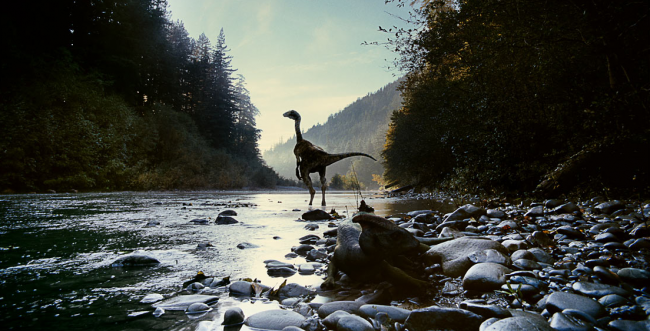
During the “lost years” following the grueling production and ultimate success of “Days of Heaven,” (which turned into a 20-year stretch), Malick hid out in Paris and worked on a movie tentatively titled “Q.” According to the lengthy and in-depth Vanity Fair article that came out right before “The Thin Red Line,” the film initially included “a prologue, which dramatized the origins of life.” Except that the segment “became increasingly elaborate and would ultimately take over the rest of the story.” The “origins of life” bit would make the transition to “The Tree of Life,” but otherwise, the visualization of the cosmos would have been strikingly different – “Q” featured a “sleeping god, underwater, dreaming of the origins of the universe, starting with the big bang and moving forward, as fluorescent fish swam into the deity’s nostrils.” It got fairly far along, with Malick traveling between Paris and Los Angeles where he had installed a small team, mostly comprised of photographers and special effects technicians, until one day, just like the big bang only in reverse, everything just stopped. According to visual effects supervisor Richard Taylor, “One Monday, Terry never showed up. He didn’t call anybody, we couldn’t find him… He just stopped.” Paramount funded Malick’s work on the film to the tune of $1 million—big money for the late 1970s—and according to several players in the Malick milieu, became impatient when thousands of dollars and years later, he still had not turned in a script. So they began pressuring him.

As the legend goes, Malick’s refusal to rush or to work to anyone’s timetable but his own, was the reason he moved to Paris and took what turned out to be a 20-year vacation from movies. “Q” obviously formed the early, nascent version of the “The Tree of Life,” minus the family story in Texas that gives the film its heart and pulse. And while similar, there are some radically different things about “Q.” It had a section set in the Middle East during World War I, and it also had a Minotaur, “sleeping in the water [dreaming] about the evolution of the universe, seeing the earth change from a sea of magma to the earliest vegetation,” according to Taylor. The script was said to be 250 pages long, which is about 50 pages longer than the epic 198-page ‘Tree of Life’ script. Considering how much of its “origin of the universe” concept Malick seems to have cannibalized for ‘Tree Of Life,’ it’s probably impossible that we’ll ever see this film, but we suppose he could one day utilize some of its other discarded elements.
“The Moviegoer”/“Desert Rose”
With no films coming in the near-two-decades between “Days of Heaven” and “The Thin Red Line,” Malick had to support himself somehow after his production deal with Paramount ended in 1983. He brought home the bacon by writing scripts for hire, with Peter Biskind in Vanity Fair mentioning an unnamed project for Louis Malle (if only that had come to pass…) and a rewrite on “Countryman,” a script by Robert Dillon (”French Connection II,” “Waking the Dead”) that was never produced. Perhaps the two best known of this era (bar “Great Balls of Fire!,” more on which below) were two novel adaptations: “The Moviegoer,” based on the classic novel by Walker Percy, and “The Desert Rose” by Larry McMurtry, author of the source material for “Lonesome Dove” and “Terms of Endearment.”

It’s unclear whether “The Moviegoer” was an assignment or self-generated, but either way, the book, which Time Magazine named one of the 100 greatest of their lifetime in 2005, appears to have been prime Malick territory. The existential tale follows a stockbroker and Korean War veteran in 1950s New Orleans, a man who connects more with film and literature than he does with his own life. It’s fascinating to wonder what Malick would have made of it (and surely that script is floating out there somewhere), but if he ever had plans to direct it himself, as it seems he did, they’re long gone: one of the many casualties of Hurricane Katrina. Malick told the audience at a rare Q&A in Bartesville (where his next film is mostly shot) around the release of “The New World” that he’d given up on the idea, saying “I don’t think the New Orleans of the book exists anymore.” Still, it’s wormed its way into popular culture regardless: it’s a definite influence on “Mad Men.”
As for “The Desert Rose,” that was a strict paycheck gig: Rob Cohen, of all people, the future director of “The Fast & The Furious” and “xXx,” was at the time the head of Taft-Barish Productions and hired Malick to write the script with the intention that Barry Levinson, hot off “Diner” and “The Natural,” would direct. The book isn’t what you’d think of as obvious Malick material—it’s a Vegas-set tale of a fading showgirl and her daughter, not a million miles away from “Mildred Pierce”—but again, it would have been fascinating to see him out of his comfort zone. “The Desert Rose” came close to making it to the screen again later, with Nora Ephron being announced in the trades as director, with sister Delia Ephron writing the script for Columbia in 2002, although again, it didn’t come to pass.
“Jerry Lee Lewis/Great Balls of Fire”
Details on this one are a bit thinner and some of it is a little confused, but bear with us. Once again, during those supposed “lost years” of the ‘80s, Terrence Malick was commissioned to write a script about Jerry Lee Lewis. Described in a Los Angeles Magazine profile as being “much darker” than Jim McBride’s “Great Balls of Fire!” released in 1989, Malick’s work was not used despite some sources saying he is “uncredited” on the film. Well, Malick has hung on to the script and it still could be a possible project.

Last fall, two decades on from the Dennis Quaid- and Winona Ryder-starring picture, there was some brief new life kicked into the film. Buried in a report over at THR, word emerged that Brad Pitt—one of the producers of “The Tree of Life”—was also developing the apparently-still-gestating Jerry Lee Lewis project and that Natalie Portman had been offered a lead role. And, well, that’s about it. There’s not much about what the script contains or what the film centers on, but we’d wager it goes a bit further into the musician’s decline following the scandal surrounding his marriage to his first cousin, that found his pay rate for concerts slashed and his popularity waning. Lewis also suffered the tragic loss of two of his children in the ‘60s and ‘70s.
However, as quickly as news arrived of this project still being alive, it vanished. While there have been talks about a variety of Malick’s upcoming movies (check the outro), word on Jerry Lee Lewis has once again grown quiet.
“Che”
Before Terrence Malick was a filmmaker, the Rhodes Scholar and Harvard philosophy major briefly toyed with a journalism career, with a brief stint at Newsweek and a gig for Life magazine covering Latin America before moving to the New Yorker, where he had an office from 1968-1969. And it was here that Malick first showed his interest in Che Guevara.

His biggest piece of writing—that, of course, he never finished—was centered on the imprisoned French philosopher Régis Debray who had been working with Che. Paul Lee, a philosophy instructor at Harvard and MIT told GQ, “I have a memory of it piling up to six feet of copy. He got obsessed, and he overwrote, and he went past it. He never finished it.” And though he never finished the article his interest in the subject remained strong.
Fast forward three decades to 1999—just after “Traffic” came out—when Steven Soderbergh, Benicio Del Toro and Laura Bickford began developing their movie, “Che.” Upon finding out about Malick’s aforementioned article and his journeys in Bolivia, they approached the director to helm the project. “I said to him the list of people that I’d be willing to step aside for, to see their version as opposed to mine is pretty short, but you’re at the top of it,” Soderbergh told Film Comment.
Malick’s take on the film was described as “intense,” as his version would’ve solely focused on Che’s 1966–67 Bolivian campaign (or what would comprise “Guerilla,” the second half of Soderbergh’s film). But when financing and scheduling failed to connect, Malick bailed, moving on to “The New World” instead and Soderbergh then took on the film more out of necessity than passion. And not only that, he needed to bang out a new script.
“Although I love movies about quixotic journeys, there was no context. It was unreadable.” Soderbergh said. “You couldn’t do the detail, you couldn’t get a sense of the rhythm of what their days were like. And we had a start date approaching. I said we have to stop and think about this. And two weeks later, I said it needs to be two movies. We need to break it in half, and do each movie in the way we feel is appropriate, and by the way, we’ve got to do them in Spanish. For Laura, this is interesting news. We now have two movies so all the deals have to be redone. And Peter [Buchman, the credited screenwriter for both films] and Benicio sat down and started from scratch to do Cuba.”
More recently, producer Bill Pohlad—who was pitched “The Tree of Life” around the time Malick was on “Che”—agreed that the script for “Che” was a challenge, telling The Wrap it was a “daunting project, and Terry’s script for ‘Che’ was not an easy read, or a typical read.”
In an incredibly rare public appearance at the 2007 Rome Film Festival, Malick hinted at his past as a reporter for The New Yorker. “Yes,” Malick said. “I was sent to Bolivia to do a piece on Ernesto ‘Che’ Guevara, but frankly I did not understand what was going on.”
We’re sure in the intervening years—and given his penchant for research and accuracy—he got a handle on Che’s Bolivian campaign but it sounds rather like his resulting film might have turned out not unlike “The Thin Red Line,” perhaps similarly ethereal and spiritual, investigating the daily grind of the revolutionary from ground level. We’ll never know (unless someone wants to send us that script) but as far as sudden backup jobs go, Soderbergh did some remarkable work at the last minute on “Che,” which pretty much completely changed direction after Malick bailed.
And The Rest:
So, believe it or not, even with all the above, there are even more Terrence Malick projects that have popped up over the years and could still be on the horizon. With “The Tree of Life” now in theaters, fans of the director will remember that at one time it was put forward that the film would be accompanied by a parallel IMAX documentary “Voyage of Time.” Well, that clearly didn’t happen, but it’s still in the works.

“It’s still a strong desire of Terry’s and we’re all kind of working on getting it together… There will be footage that we shot during the course of ‘Tree of Life,’ but it won’t be that same footage,” producer Bill Pohlad said at the Hollywood premiere of “The Tree of Life.”
As you might expect, the documentary will be similar to the free-form cosmic narrative in “The Tree of Life,” but Malick is still shooting. “...Again, it’s going to change, too. There’s some new stuff getting shot,” producer Dede Gardner said. Of course, no word on when or if this will ever get done but it’s definitely still moving.
In fact, the suddenly prolific director seems to be juggling a few things at once. He has also told his production team to keep their summer and fall calendars open for another untitled project that apparently would be finished “in a matter of months.” There are no details (of course) but an anonymous commenter said “it’s actually about a musician and, like the [other] untitled project, is set in modern times and it’s shooting in Austin.” So perhaps a mutation of his Jerry Lee Lewis script?
But what about the stuff that didn’t get made and seems to be buried (for now)? Well, as we mentioned earlier, in the late 1970s, Malick was offered the chance to adapt David Rabe’s play “In The Boom Boom Room” about a young go-go dancer in 1960s Philadelphia and her troubled journey through love and sex. Malick turned down the film. At some point in his career, Malick penned a reworking of Robert Dillon‘s “Countryman,” which he wrote for Ned Tanen at Universal as a kind of modern-day “Grapes of Wrath,” but additional info on its existence is scarce. As mentioned, in the 1980s, Malick was said to be working on a script for Louis Malle—he summered at Malle’s country home several times—but it appears nothing came of it (paging Malle’s wife Candice Bergen?).
But in 1991, Malick was attached to produce an adaptation of Graham Greene’s “Brighton Rock.” Don MacPherson was penning the screenplay with Grant Hill (“The Thin Red Line”) co-producing. Obviously it never came together. But fast forward nearly two decades and the film has hit theaters, but in a completely different form with none of those names involved: Rowan Joffe wound up writing and directing the picture, which was met with lukewarm reviews late last year.

More recently, in 2002, Malick was reported to be producing a “fictional documentary” with Richard Linklater set to direct. The first half of the film was set to be shot that year with a Bay City, Texas high school giving filmmakers approval to film their football team. The following year the production was supposed to follow four of the teammates in their post-high school lives. It seems cameras never rolled.
Also in 2002, “The Thin Red Line” star Jim Caviezel told The Independent that Malick was working on an adaptation of the Middle English poem “Gawain and the Green Knight.” The epic poem chronicles a challenge posed by the titular knight, who says any man may strike him if he agrees to receive a blow in a year and a day. Gawain beheads him, but the Green Knight reattaches his head and makes Gawain promise to meet him again as agreed. It’s certainly the most fantastical of the Malick projects that have been bandied about.
And in what would have been a truly powerhouse team up, Variety reports that in 2003 Malick had yet another producing project in the works with none other than Robert Redford set to star. “Aloft,” based on Alan Tennant‘s nonfiction book, centers on a personal passion for Malick—birds. Entertainment Weekly summarized the plot at the time as following two guys in a beat-up Cessna Skyhawk who track peregrine falcons on their long migration from the Arctic to South America. Along the way they get into trouble. “ ‘Aloft’ is a great buddy adventure tale with a unique scientific spin as these two irrepressible characters are chased by the American Army, the Canadian Mounted Police, South American drug lords and Mexican bandits. Sometimes fact is stranger than fiction, and in Alan Tennant’s book, it is also a lot of fun,” producer Jake Eberts said. Erik Jendresen (“Band of Brothers”) was going to pen the script, and no director was attached; needless to say, it never took flight.
Somewhat randomly, in 2007 Powers Boothe revealed he was working with Malick on a television project that nearly got made. “In fact, there was a point where Terry Malick and I were talking seriously about getting a series together,” he told Texas State University. “He was going to do the story for it. We were going to shoot it in Austin. It fell apart at the last minute.”
So how about some scripts for films that did get made? There was “The Gravy Train,” a 1974 film co-written by Malick under the pen name David Whitney, and not only that, he was apparently the original director before getting replaced by Jack Starrett. The film follows small town West Virginia brothers Calvin (Stacy Keach) and Rut Dion (Frederic Forrest) who quit their factory jobs to make their fortunes as armed robbers in Washington D.C. and zaniness ensues. The film, later re-released under the title “The Dion Brothers,” is pretty hard to get a handle on, but does have fans in Quentin Tarantino and David Gordon Green, who cited it as an influence on “Pineapple Express” (let’s not forget Malick produced Green’s “Undertow,” one of a brief spate of producing credits in the mid ‘00s, alongside Vietnamese drama “The Beautiful Country” and Michael Apted‘s slavery biopic “Amazing Grace”). You can check out more details and stills over at Obscure One Sheet.

Finally, there is the trucking comedy “Deadhead Miles” that was made into a film starring Alan Arkin, Richard Kiel, Hector Elizondo and interestingly enough, Ida Lupino and George Raft as themselves. But directed by Vernon Zimmerman, it was considered so bad Paramount Pictures has never officially released it, though it is streaming on Netflix Instant and if you want to own it, you can snag a bootleg. The film popped up at festivals in the ‘70s and ‘80s but that’s about it. You can check out more info and an official still over at Obscure One Sheet.
If anything, this diversity of lost, dormant or abortive projects reveals a director whose interests are far more wide-reaching—and in some cases, perhaps populist—than he typically gets pegged for. While he has a rep for gravitating towards the big questions, he seems equally drawn to smaller-scale stories.
What’s next? Well, there’s a romance picture starring Ben Affleck, Rachel McAdams, Javier Bardem, Barry Pepper, Rachel Weisz, Jessica Chastain, Olga Kurylenko and, apparently, Amanda Peet, rumored to be called “The Burial,” and purported to center on a man obsessed with a deceased lover.

Shot quickly in Oklahoma with a small crew, could this project be a return to his “Badlands”-like years? It’s something that’s been hinted at recently. “He would like to make them smaller or at least he talks about making his films smaller,” Jack Fisk said on the 2007 Criterion Collection commentary for “Days of Heaven.” “He misses the intimacy of ‘Badlands’ even though it was a rough experience for him. He does miss it, he likes the smaller aspect, smaller crews for sure.” While that sounds a bit like the smaller, family elements of the epic “The Tree of Life,” it also sounds similar to what was done on “The Burial.” Malick has been pushing the envelope of deconstructed narrative with each successive picture and this untitled romance is apparently “even more experimental than ‘Tree of Life,’ ” which is a tantalizing thought, considering the picture doesn’t outwardly have Kubrick-ian sci-fi elements. An experimental romantic drama from Terrence Malick possibly centering on death? Hell, yes, please.
-Joey's Two Cents: I found this rather fascinating...thoughts?